

1:What Are Rivet Nuts?
1.1: Basic Structure of Rivet Nuts
A rivet nut of three main parts: head, shank and threaded hole. The shank deforms under pressure during installation to grip panels tightly. The built-in thread works with bolts for firm fastening. It is an integrated compact piece.
1.2 Main Features of Threaded Rivet Nuts
1.No pre-tapping needed. It creates reliable threads on thin plates and hollow parts easily.
2.Easy one-sided installation, no work required on the opposite side.
3.High connection strength suitable for repeated assembly and disassembly.
2:Key Specifications of Rivet Nuts
Below are the key specifications of rivet nuts for practical selection and use.
2.1 Common Size Range (Metric & Imperial)
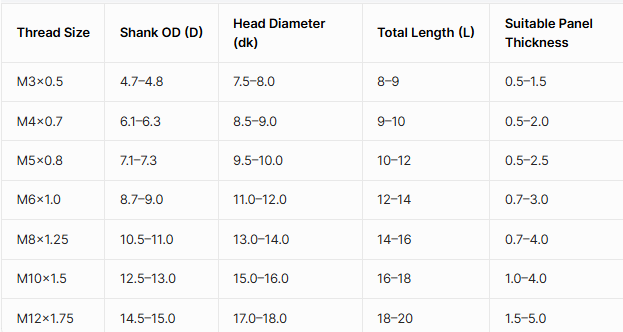
Rivet nuts Metric sizes to match global assembly demands.
Rivet nuts Imperial size as below
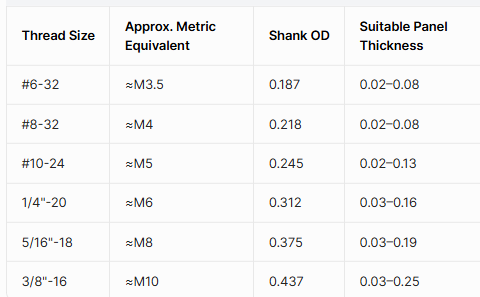
2.2 Main Material Options
The most widely used are carbon steel and stainless steel. Aluminum is also adopted for applications requiring light weight and basic fastening performance.
2.3 Technical Parameters & Load Capacity
Each model has fixed standard dimensions and clear load ratings. It includes pull-out resistance and shear resistance data, which directly reflect the bearing capacity. Users can pick suitable products according to actual load requirements.
2.4 Surface Treatment Standards
Surface treatments are applied to boost durability and anti-rust ability. Common processes include whitce zinc plating ,Yellow zinc plated and passivation. All treatments follow industry standards, to resist corrosion and extend service life in regular working conditions.
3: Main Applications of Rivet Nuts
3.1 Automotive Industry
Rivet nuts are commonly used for automotive interior and exterior assembly.
3.2 Electronic & Electrical Equipment
Electrical and electronic products require lightweight and compact assembly. Rivet nuts are small and will not damage thin equipment casings. They are widely used for fixing control panels, electrical boxes and communication device shells.
3.3 Construction & Decoration
In construction and decoration, many installation positions only support single-sided operation. Rivet nuts can be installed fast without welding or pre-tapping. They are mainly used to fix curtain wall parts, metal decorative plates and wall brackets
3.4 Machinery & Furniture Manufacturing
Mechanical equipment and metal furniture mostly use thin metal plates that cannot be tapped directly. Rivet nuts create sturdy threads on thin materials to fix equipment shells, brackets and furniture frames steadily. Standard sizes suit mass production and help lower assembly costs.
4: Types of Rivet Nuts & Selection Guide
4.1: Different Head Styles
Open end rivet nut,seal end rivet nut , half-hex rivet nut ,full hex rivet nut.
4.2: How to Choose the Right Rivet Nut
Match rivet nut length to your sheet metal thickness.
Use the correct pilot hole size. Too big and it slips; too small and you cannot install it.
Pick styles based on load. Flat head for light use, countersunk or knurled types for heavy load and sealing.
Choose materials properly. Use steel rivet nuts on steel panels, aluminum ones on aluminum panels to avoid corrosion.
Choose material by working conditions. Stainless steel for wet or outdoor areas, zinc plated carbon steel for regular use.
For more details ,you can contact us !
Post time: Jun-08-2026