

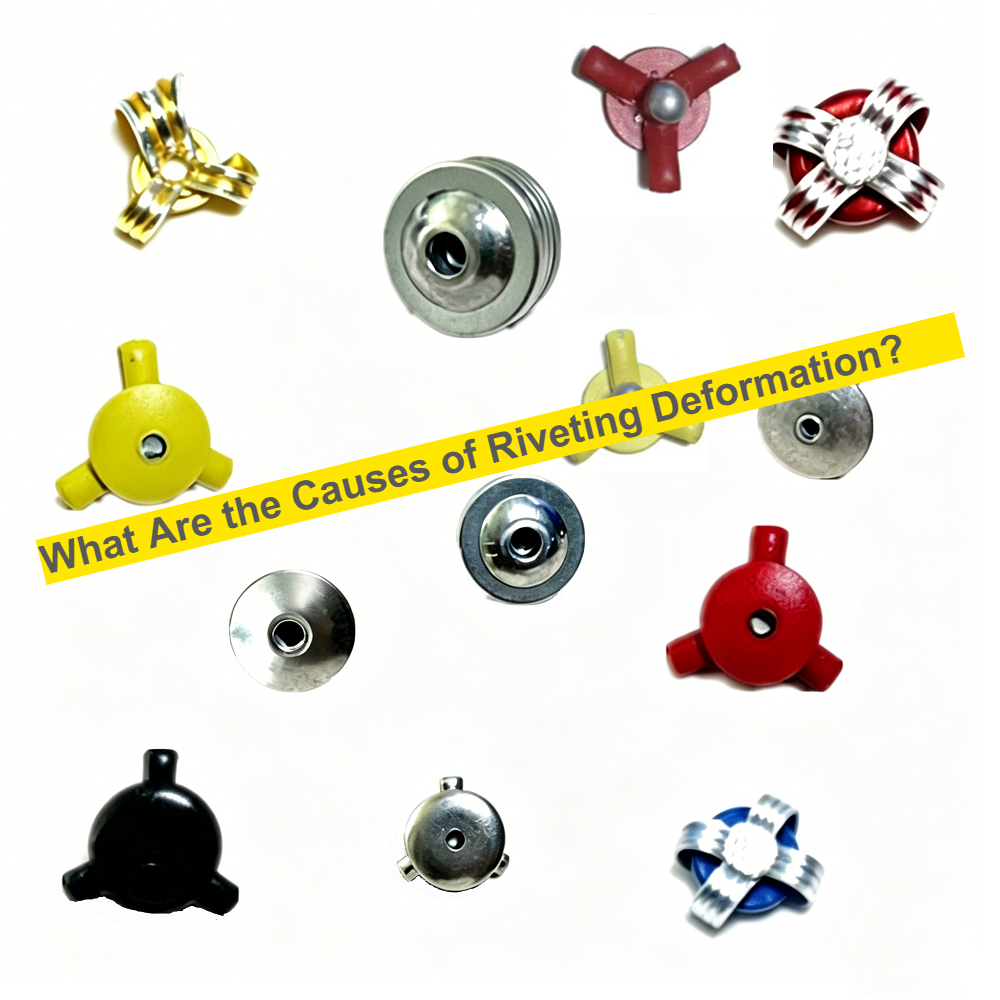
In industrial processing, riveting deformation is a common quality problem that directly reduces assembly accuracy, weakens joint strength, and even affects the appearance and service life of products. To effectively solve this issue, manufacturers must clarify the root causes of deformation and implement targeted control measures.
What Is Riveting Deformation?
Riveting deformation refers to the unwanted shape changes of rivets or connected components during the riveting process, including bending, warping, bulging, hole expansion, and uneven rivet head forming. Under external pressure, the rivet undergoes plastic deformation: its shank expands and presses against the hole wall, resulting in non-uniform internal stress and最终 structural distortion.
Main Causes of Riveting Deformation
1. Process Parameter Problems
Unreasonable settings of riveting force, speed and holding time are the primary inducements of unstable deformation and dimensional deviation.
2. Material Factors
Mismatched hardness between rivets and workpieces leads to uneven deformation resistance. Poor material plasticity easily causes cracking or excessive local deformation. In addition, thin-wall or soft materials are highly sensitive to pressure and prone to warping during riveting.
3. Tool & Mold Issues
Worn or misaligned dies disrupt the forming track and trigger eccentric deformation. Excessive friction between molds and rivets hinders metal flow, resulting in irregular shapes. Incorrect mold gaps also lead to insufficient or excessive interference fit.
4. Operation & Assembly Errors
Improper rivet length or protrusion causes unstable forming. Hole position deviation or mismatching leads to forced assembly and residual internal stress. Inconsistent manual operations (such as impact force, angle and frequency) result in unstable quality. Disordered multi-rivet assembly sequence further causes accumulated stress and overall warping.
Term Note for Swahili-speaking Users:
Deformation = Umagharibu
Riveting deformation = Umagharibu wa kuchambua
Effective Measures to Reduce Riveting Deformation
To control riveting deformation, enterprises can take the following key measures: optimize riveting force, speed and holding time; select matched rivet and workpiece materials; regularly maintain molds and ensure precise alignment; standardize operation sequences and adopt automated equipment; control working temperature and implement accurate pre-assembly.
Post time: May-12-2026