

Blind Rivet Installation: Complete Step-by-Step Guide
Blind rivets, also known as pop rivets, are referred to as remache (remaches en ingles/remache in english) in Spanish. They are a widely used fastener, suitable for scenarios where the connection surface can only be accessed from one side. Whether it is the automotive rivets (remache para carro) used in auto maintenance or the metal rivets (remaches para metal) used in metal processing, blind rivets can provide a firm and permanent connection effect. Whether you use aluminum rivets (remaches de aluminio), solid aluminum rivets (remaches solidos de aluminio) or impact rivets (remaches de golpe), mastering the correct installation steps is the key to ensuring connection strength and durability. This article will detail the installation process of blind rivets and provide core skills for selecting rivet guns (remachadoras) and rivets, helping to achieve efficient installation in various scenarios.
Before starting installation, prepare all required tools and materials in advance. The core tool is a rivet gun. You may choose a manual, battery-powered or pneumatic model according to the project scale and rivet type: a manual rivet gun is sufficient for small DIY projects or light-duty applications; pneumatic or battery-driven models are recommended for industrial-grade or mass installation tasks to boost efficiency.
Select rivets suited to the application scenario: aluminum rivets feature good corrosion resistance and are ideal for humid or outdoor environments; solid aluminum rivets deliver higher strength and are applicable to structural component connections; pop rivets allow fast installation and are suitable for one-time joining scenarios.
In addition, prepare a drill bit (with a diameter matching the rivet), deburring tools, cleaning supplies, and personal protective equipment to prevent injuries caused by metal debris.
Step 1: Prepare materials and drill holes.
First, align the two workpieces to be joined (e.g., metal sheets for metal rivets, auto parts for automotive rivets) and mark the preset rivet positions.
The drill bit size is critical. It is recommended to use a drill bit 0.1 mm larger than the rivet diameter, ensuring the rivet fits tightly against the hole wall without looseness.(Example: For a 3.2 mm blind rivet, use a 3.3 mm drill bit; for a 4 mm blind rivet, use a 4.1 mm drill bit; for a 4.8 mm blind rivet, use a 4.9 mm drill bit.)
After drilling, remove burrs around the hole edge with a deburring tool to prevent scratching the rivet and compromising joint tightness. Meanwhile, clean away dust and metal debris.
Step 2: Select a suitable rivet and insert it into the hole.
Choose the right type of rivet according to the application scenario: aluminum rivets (remaches de aluminio) are preferred for outdoor and humid environments; solid aluminum rivets (remaches solidos de aluminio) are used for load-bearing structural positions; impact rivets (remaches de golpe) are suitable for occasions requiring fast installation; dedicated automotive rivets (remache para carro) are adopted for automobile maintenance, ensuring compatibility with automotive materials (aluminum, steel, etc.) to prevent premature wear and corrosion.Insert the selected blind rivet into the pre-drilled hole, and ensure the rivet head is flush with the surface of the material.
Step 3: Fasten the rivet with a rivet gun.
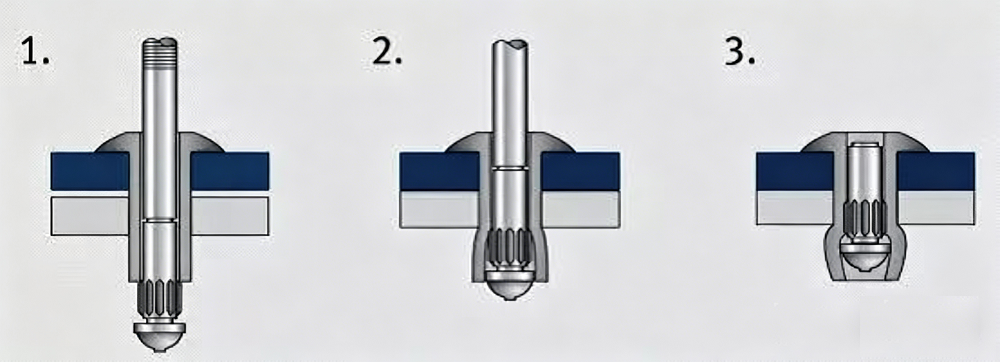
Aim the nozzle of the rivet gun at the mandrel of the rivet (the slender metal rod). Keep the rivet gun perpendicular to the rivet head and hold it firmly to ensure even pressure.For a manual rivet gun, squeeze the handles steadily; for a pneumatic or electric rivet gun, activate the switch. Keep operating until the mandrel is pulled off, the rivet tail expands, and clamps the two pieces of material tightly to form a firm joint.
Step 4: Post-installation Inspection and Precautions.
After installation, inspect the fastening condition of each rivet one by one to ensure there is no looseness or deformation. In particular, automotive rivets and metal rivets must meet the required connection strength.
When using a rivet gun, avoid applying excessive force which may cause material deformation. When selecting rivets, match them to the material thickness and load-bearing requirements, and do not use mismatched specifications (for example, using ordinary aluminum rivets as a substitute for solid aluminum rivets).
In addition, aluminum rivets are not suitable for high-temperature and high-load working conditions. For special application requirements, protective coatings can be used to improve durability.
Blind rivets feature a simple and efficient installation process. As long as you follow the correct procedures and select the right rivets and rivet guns, you can achieve stable fastening results.
You can follow our photo or procedures ,or else you can contact us for more details .
FAQ:
Q:What is blind rivet installation?
A:Blind rivet installation is the process of fixing two or more materials together using a blind rivet. It only requires access to one side of the workpiece, no need for double-sided operation. It is widely used in construction, automotive, furniture and metal sheet DIY assembly.
Q:What tools do I need for blind rivet installation?
A:The basic tools for blind rivet installation include a hand rivet gun, drill, measuring tape, marker and sandpaper. For different rivet sizes, you also need matching drill bits and replacement nosepieces for the rivet gun
Q:What mistakes to avoid in blind rivet installation?
A:using the wrong rivet size, drilling oversized or undersized holes, pulling the rivet gun too fast, installing on uneven surfaces, and not trimming sharp edges after installation. These errors will cause loose connection or rivet failure.
Post time: May-07-2026