

The rivet shank is as the load-bearing core of all rivet parts. Every rivet, whether solid, blind, semi-tubular or structural ring-grooved, is built around the shank plus complementary rivet parts that complete clamping and locking functions.
1.1 Rivet Shank: The Central Load-Carrying Body
The rivet shank refers to the cylindrical main shaft that passes through pre-drilled holes of stacked workpieces, bearing shear, tension and vibration stress throughout the joint’s service life. Its three core specifications directly determine rivet performance:
Shank Diameter:
Standard sizes range from 2.4mm up to 12mm for industrial use. Undersized shanks create loose holes and weak clamping.
Grip Length (Shank Effective Length):
The usable section of the shank that fits the total thickness of joined materials. Selecting a shank with insufficient grip fails to form a full rear bulb; excessive grip leads to uneven deformation and loose connections under cycling loads.
Shank Material & Coating:
Common raw materials include aluminum alloy, carbon steel, 304/316 stainless steel, copper and brass. Zinc plating, galvanization or passivation coatings are applied to the shank surface to block oxidation and galvanic corrosion between dissimilar metal panels.
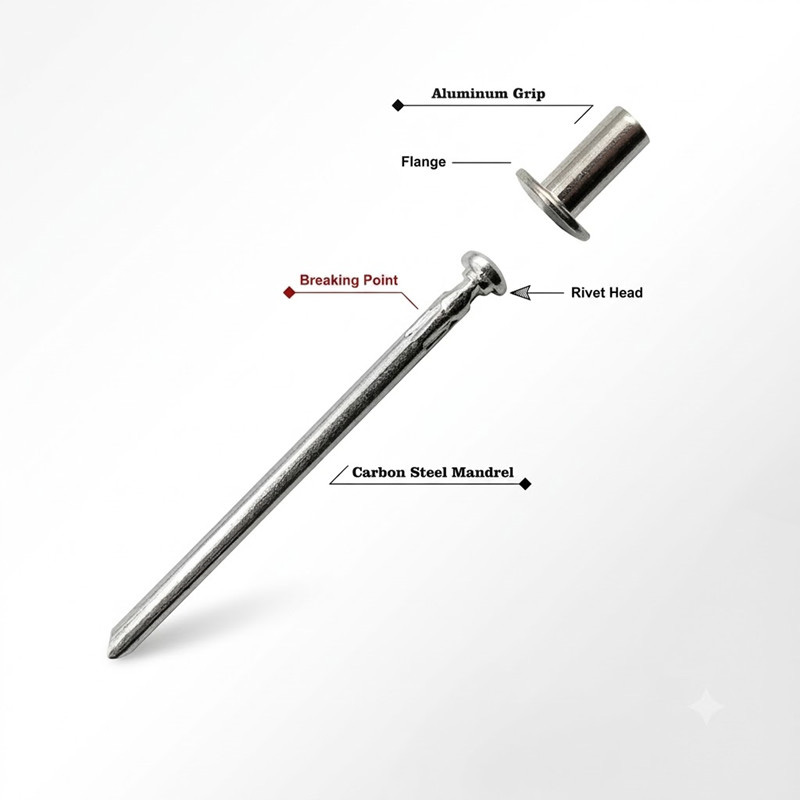
1.2 Primary Supporting Rivet Parts Paired With the Shank
1.2.1 Rivet Head
The head provides a wide bearing surface to spread clamping force evenly across the front panel surface, preventing pull-through under tension. Industry standard head variants include:
● Dome head: General assembly, largest contact area, widely used for metal cabinets and equipment frames
● Large flange wide head: For thin, brittle substrates like plastic sheets and aluminum composite panels
● Countersunk head: Flush surface finish requirement, typical for automotive body panels and aerospace components
● Small flat head: Compact mounting for narrow edge spaces and mini electronic housings
1.2.2 Deformable Tail Section of Rivet Shank
Blind rivets: The hollow shank tail collapses and balloons into a bulb lock when the mandrel pulls through, forming a permanent rear anchor without needing access to the back of the assembly.
1.2.3 Mandrel
The mandrel is a separate steel pin running through the hollow rivet shank, a critical rivet part unique to pop/blind rivets.
1.2.4 Sealing Washer & Lock Collar (Specialized Rivet Parts)
For watertight blind rivets and high-vibration structural rivets, extra rivet parts are matched to the shank:
● Rubber/nylon sealing washer: Fits between rivet head and panel to block water, dust and gas penetration for outdoor and electrical enclosures
● Steel lock collar: Used on Huck ring-grooved rivets, locks onto the deformed shank groove to eliminate loosening under continuous mechanical vibration (trucks, heavy machinery, railway equipment)
2. Classification of Rivet Components
Rivet components are grouped by rivet structural design, as each category carries distinct shank geometry and supporting parts.
2.1 Single-Piece Rivet Components (Solid Body, One Integrated Shank Unit)
These rivets consist of only two core rivet parts: formed head + integral solid shank, no separate internal mandrel. Installation requires access to both sides of the workpiece to deform the shank tail.
2.2 Two-Piece Blind Rivet Components (Hollow Shank + Separate Mandrel)
The most widely used rivet type for one-sided assembly, split into two independent rivet parts: rivet shell (hollow rivet shank) and mandrel pin. Subcategories based on shank function:
1. Standard open-end blind rivets
● Rivet parts breakdown: Flange head + smooth hollow shank + steel mandrel
2. Closed-end sealed blind rivets
● Rivet parts breakdown: Wide flange head + fully sealed hollow shank + corrosion-resistant mandrel
3. Multi-grip bulb rivets
● Rivet parts breakdown: Large flange head + variable-diameter expandable shank + high-tensile mandrel
2.3 Multi-Component Structural Rivet Systems
Heavy-duty vibration-resistant rivets built with three or more rivet components beyond the base shank:
● Ring-grooved Huck rivets: Rivet sleeve (shank) + serrated mandrel + steel lock collar; the shank features circumferential grooves that interlock with the collar after mandrel pullout
● Tri-fold multi-grip rivets: Reinforced thick-wall shank + segmented expandable tail + hardened mandrel; three-way shank expansion delivers superior pull-out resistance for commercial vehicle chassis
Post time: Jun-23-2026