

Pre-Operation Safety Preparation & Rebite Inspection
Complete pre-operation safety checks are the primary premise for safe riveting and standardized rebite construction. Before starting any riveting work, workers must conduct comprehensive inspections of the operating environment, equipment, and raw materials to eliminate potential risks in advance.
First, environmental safety inspection is critical. The riveting working area must be kept clean and tidy, with no scattered metal scraps, oil stains, or sundries that may cause slipping or collision.
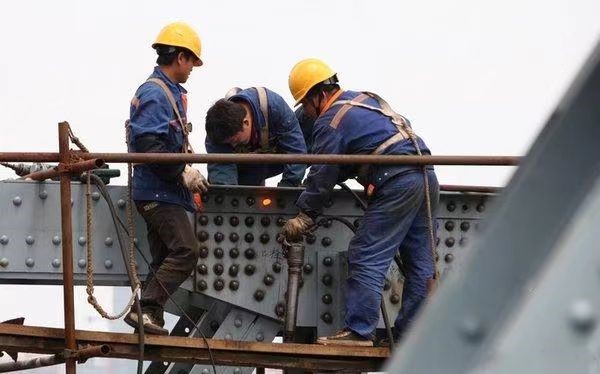
Second, tool and equipment inspection is the core of pre-operation safety. Common riveting tools include pneumatic rivet guns, hand riveters, and hydraulic riveting equipment. Workers need to check whether the tool air pressure, pipeline connection, and switch control are normal to prevent equipment failure such as air pipe detachment and tool jamming during high-intensity operation.
In addition, personal protective equipment (PPE) must be worn in place. Workers shall wear anti-impact safety goggles to block flying metal debris generated during riveting and rebite processes, wear anti-slip and anti-extrusion labor gloves to reduce tool vibration damage and avoid hand scratch injuries. For long-term riveting operation, noise reduction earmuffs are also required to prevent occupational noise hearing damage caused by continuous tool impact noise.
Standard Rebite Operation Safety Techniques
Rebite is the key finishing process of riveting construction, which directly determines the fastening tightness, flatness and structural safety of riveted parts. Non-standard rebite operation will cause problems such as incomplete rivet flattening, asymmetric forming, loose connection, and even local stress concentration of components, inducing structural cracking and falling off. Therefore, standardized rebite safety techniques must be strictly implemented in actual operation.
The first core technique is accurate positioning and stable fixing. Before rebite construction, the rivet and the connected workpiece must be tightly fitted without gaps or displacement. Workers need to fix the workpiece with a positioning fixture to avoid workpiece shaking during rebite impact, which leads to deviation of rivet forming position. Accurate positioning can ensure uniform stress on the rivet, improve the firmness of the connection, and avoid secondary reworking and safety risks caused by offset rebite.
The second key point is to control reasonable impact force and operation frequency. Whether using pneumatic or manual riveting equipment, excessive impact force will cause excessive deformation of the rivet and even damage the surface of the connected workpiece, while insufficient force will lead to unqualified rebite forming and loose fastening. In actual operation, the impact strength should be adjusted according to the rivet material, diameter and workpiece thickness, and continuous high-frequency impact should be avoided. Interval operation is adopted to ensure gradual and uniform forming of the rivet head, so as to achieve standardized rebite effect.
In addition, keep the operating posture standard. Workers need to keep their bodies stable, hold the riveting tool vertically aligned with the rivet center, and avoid oblique impact. Oblique rebite will cause eccentric stress on the rivet, resulting in unbalanced local force of the component, which greatly reduces the structural safety and service life. Standard operating posture can also effectively reduce the risk of tool slipping and hand injury.
Standard Rebite Operation Safety Techniques
Rebite is the key finishing process of riveting construction, which directly determines the fastening tightness, flatness and structural safety of riveted parts. Non-standard rebite operation will cause problems such as incomplete rivet flattening, asymmetric forming, loose connection, and even local stress concentration of components, inducing structural cracking and falling off. Therefore, standardized rebite safety techniques must be strictly implemented in actual operation.
The first core technique is accurate positioning and stable fixing. Before rebite construction, the rivet and the connected workpiece must be tightly fitted without gaps or displacement. Workers need to fix the workpiece with a positioning fixture to avoid workpiece shaking during rebite impact, which leads to deviation of rivet forming position. Accurate positioning can ensure uniform stress on the rivet, improve the firmness of the connection, and avoid secondary reworking and safety risks caused by offset rebite.
The second key point is to control reasonable impact force and operation frequency. Whether using pneumatic or manual riveting equipment, excessive impact force will cause excessive deformation of the rivet and even damage the surface of the connected workpiece, while insufficient force will lead to unqualified rebite forming and loose fastening. In actual operation, the impact strength should be adjusted according to the rivet material, diameter and workpiece thickness, and continuous high-frequency impact should be avoided. Interval operation is adopted to ensure gradual and uniform forming of the rivet head, so as to achieve standardized rebite effect.
In addition, keep the operating posture standard. Workers need to keep their bodies stable, hold the riveting tool vertically aligned with the rivet center, and avoid oblique impact. Oblique rebite will cause eccentric stress on the rivet, resulting in unbalanced local force of the component, which greatly reduces the structural safety and service life. Standard operating posture can also effectively reduce the risk of tool slipping and hand injury.
Post time: May-27-2026