

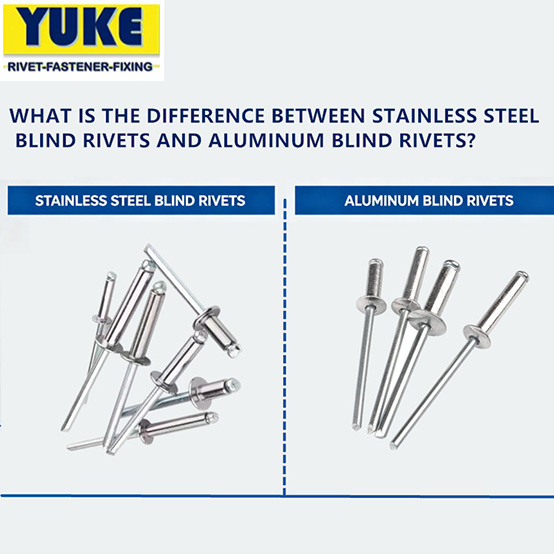
Blind rivets (pop rivets) are widely used in manufacturing, construction, automotive and Home DIY Decoration. Stainless steel and aluminum blind rivets are the two most common options, with clear differences in strength, weight, corrosion resistance, cost and usage scenarios. Below information covers their key differences to help you select the right rivet for your project.
2. Basic Overview of Stainless Steel & Aluminum Blind Rivets
2.1 What Are Stainless Steel Blind Rivets?
Stainless steel blind rivets are durable fasteners commonly made of A2(304) or A4 stainless steel. It is with high tensile and shear strength, along with excellent corrosion resistance. Ideal for heavy-duty and harsh environment use, they maintain stable fastening under heavy loads, high humidity and corrosive conditions.
2.2 What Are Aluminum Blind Rivets?
Aluminum blind rivets are lightweight fasteners made from aluminum alloy. They feature good ductility and easy installation. Their moderate strength makes them suitable for standard non-structural fastening work.
3. Main Differences Between Stainless Steel and Aluminum Blind Rivets
3.1 Strength & Load-Bearing Capacity Difference
| Comparison Dimension | Stainless Steel Blind Rivets | Aluminum Blind Rivets |
| Strength & Load-Bearing Capacity | • Hardness, tensile strength and shear strength. • Heavy loads |
• Low load-bearing capacity and poor rigidity. |
| Weight & Installation Difficulty | • Heavier and harder in texture. • Require professional heavy-duty riveting tools for installation. • Leading to higher operation difficulty and longer working time. |
• Lightweight (about 1/3 the weight of stainless steel rivets in the same size). • Soft and ductile material enables fast, labor-free installation with standard ordinary rivet tools. |
| Corrosion & Weather Resistance | • Excellent resistance to rust, oxidation, acid and alkali erosion.. | • Only basic anti-rust performance. |
| Cost & Economic Performance | • Higher raw material and processing costs. • The market price is 2–3 times higher than aluminum rivets, |
• Low production cost and affordable price. • Great cost performance, |
| Service Life & Durability | • Serve more than 10 years in harsh environments without loosening or deformation, ultra-durable. | • Poor environmental adaptability. Easy to age |
4. Application: Where to Use Each Type of Blind Rivet
| Stainless Steel Blind Rivets Applications | Aluminum Blind Rivets Applications |
| Outdoor construction, marine equipment and coastal engineering | Electronic equipment, electrical enclosures and interior decorations |
| Automotive structural parts, heavy machinery and mechanical equipment | Lightweight signage, billboards and indoor furniture assembly |
| Chemical, humid and corrosive working environments | HVAC systems, light sheet metal and civilian daily products |
| High-vibration, high-load structural fastening projects | Cost-sensitive mass production and low-stress fastening tasks |
| Projects requiring long-term durability and zero maintenance | Projects requiring overall weight reduction of finished products |
5. How to Choose Between Stainless Steel and Aluminum Blind Rivets?
5.1 Choose Stainless Steel Blind Rivets If:
Choose stainless steel blind rivets for projects requiring high structural strength and long-term durability, especially for outdoor, humid, corrosive or high-vibration scenarios where stability takes priority over cost.
5.2 Choose Aluminum Blind Rivets If:
Choose aluminum blind rivets for lightweight, low-load indoor assembly. They are ideal for dry, non-corrosive, low-vibration working environments and cost-sensitive production projects.
6. (FAQ)
6.1 Are stainless steel blind rivets stronger than aluminum?
Yes. Stainless steel blind rivets provide far higher tensile and shear strength. They support heavy-duty structural fastening.
6.2 Do aluminum blind rivets rust easily?
Aluminum rivets resist ordinary surface rust .
6.3 Are stainless steel blind rivets worth the extra cost?
Yes, for harsh and structural applications. Their long service life, stable performance and low maintenance needs fully offset their higher upfront cost.
The key differences between stainless steel and aluminum blind rivets lie in strength, durability, corrosion resistance and cost.Welcome to our factory for more details.
Post time: Jun-21-2026