

In this step, we’ll walk through the most common blind rivet issues you’ll encounter on the job. We’ll talk about what causes each problem, and share simple, workable fixes you can apply right away.
The Most Frequent Blind Rivet Issues On Site
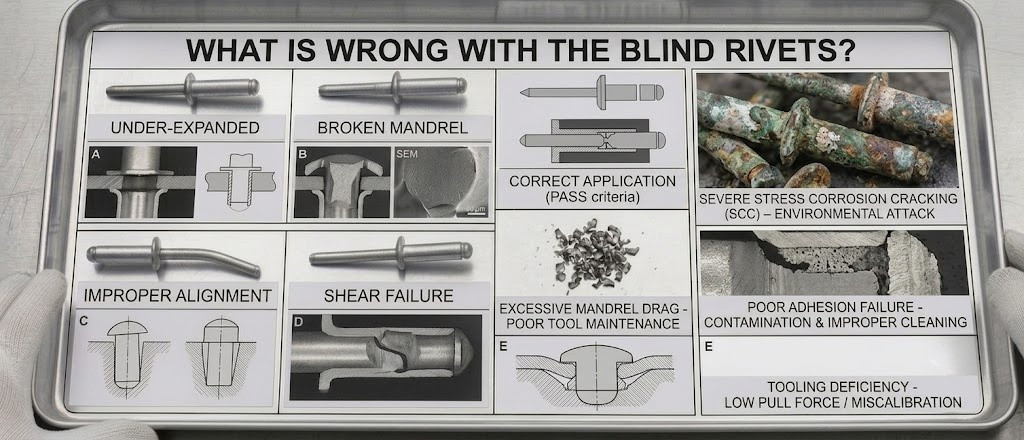
Blind rivet failures show up in a handful of typical ways. Most troubles fall into four categories, and each one points to different underlying reasons from product quality to operation mistakes.
Rivet Shank Snaps During Pulling
When you pull the rivet gun, the inner shank breaks prematurely, leaving the rivet half-set and the connection unsecured.
This usually happens when the rivet material is substandard, or you’ve picked a size that doesn’t match the hole and workpiece thickness. Pulling too hard with the tool can also snap the shank easily.
Riveted Joints Come Loose Later
After finishing the riveting work, you notice the connected parts shift or shake. Loose joints mean the assembly isn’t reliable, and it will bring hidden risks for long-term use.
In most cases, this stems from incorrect operation. If the rivet doesn’t expand fully inside the hole, it cannot hold parts tight. Using rivets that are too small for the job will also lead to loose connections.
Rivets Fail to Set Properly
You finish pulling, but the rivet head sits uneven on the surface, or the body never expands fully inside the hole. The rivet looks attached, but it does not deliver solid fastening performance.
Worn rivet guns, incomplete pulling strokes and misaligned holes are the main triggers here. Even skilled workers can run into this issue if tools are not maintained well.
Damaged or Deformed Rivet Heads
Sometimes the outer rivet head cracks, bends or flattens abnormally during installation. Aside from looking unprofessional, a damaged head also weakens the whole fastening structure.
Overpressure from the rivet gun and rough workpiece surfaces are the top two causes for this defect.
What Really Causes Blind Rivet Failures?
After sorting out common symptoms, let’s dig deeper into the root causes. Nearly all blind rivet problems come down to three key areas: the rivet itself, size matching and human/tool operation.
Poor Rivet Quality
Low-grade raw materials and rough manufacturing directly ruin performance. Rivets with uneven wall thickness, brittle metal or defective structures will fail far more often, even with standard operation. Always stick to qualified industrial blind rivets for formal assembly work.
Wrong Size & Specification Matching
Size mismatch is a very common mistake among new operators. If the rivet diameter or length does not fit the hole size and workpiece thickness, no matter how carefully you operate, riveting failure is almost inevitable.
Operation & Rivet Tool Problems
Even with good rivets and correct sizes, faulty tools or wrong steps will cause troubles. A worn, malfunctioning rivet gun cannot provide steady pulling force. Skipping standard operating steps is another major reason for repeated errors.
Practical Fixes for Common Blind Rivet Problems
These methods are tested in real work scenarios, easy to follow and require no complicated equipment.
.If the rivet shank keeps breaking: Replace any low-quality rivets with standard products, and control pulling force when using the rivet gun.
.If joints stay loose after riveting: Confirm the hole size first. Choose longer or thicker blind rivets if needed, and make sure the rivet expands completely inside the hole during pulling.
.If rivets cannot set fully: Inspect your rivet gun for wear or faults. Adjust your operating posture and pulling stroke, and keep the rivet perpendicular to the workpiece surface.
.If rivet heads get damaged: Reduce pulling pressure slightly. Clean and smooth rough areas on the workpiece before starting riveting.
Handy Tips to Avoid Blind Rivet Issues
.Source blind rivets from reliable suppliers
.Match rivet specifications strictly according to hole diameter and material thickness.
.Inspect and maintain rivet guns regularly to keep tools in good condition.
.Follow standard operating steps.
FAQ
Q: Why does my blind rivet keep breaking when pulling?
A: It is usually caused by poor material, mismatched size or excessive pulling force. Switch to qualified rivets and check size matching first.
Q: How can I stop blind rivet joints from getting loose?
A: Use properly sized rivets and ensure full expansion inside the hole. Do not use undersized rivets for thick workpieces.
Q: What are the defects of rivets?
A:Riveted joints have drawbacks including extra weight, low efficiency, material damage, poor sealing, non-reusability, corrosion risks and uneven stress.
Post time: Jun-12-2026