

After years working on blind rivet production and on-site assembly guidance, we lay out the real-world steps you can follow every time to get the correct pop rivet length.
Basic Terms You Need to Know for Blind Rivet Length Selection
Before you start calculating rivet length, three key terms have to be clear. Most new comers skip these definitions and end up sizing their rivets incorrectly.
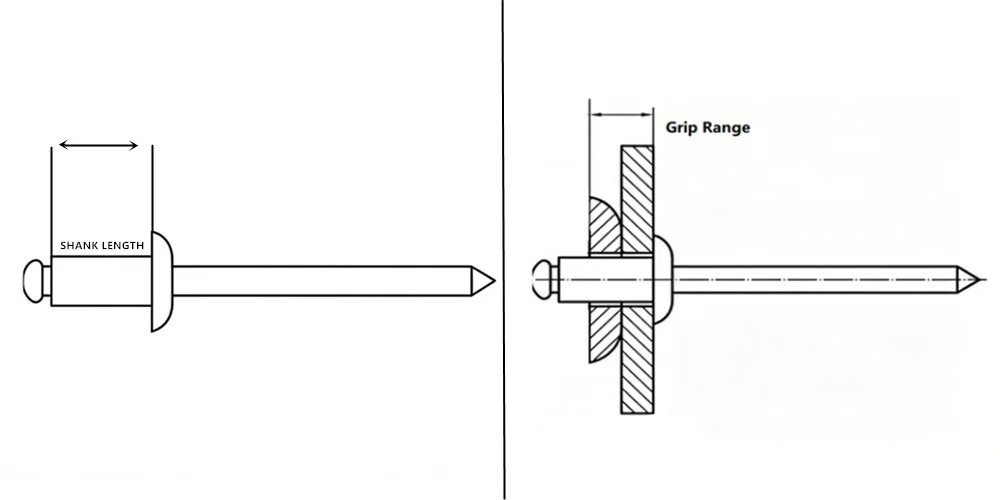
1.What Is Blind Rivet Overall Length (Shank Length)
Blind rivet length only counts the shank section below the rivet head, not including the mandrel sticking out on the end. When you order rivets, you only reference this shank measurement.
2.What Is Grip Range of a Pop Rivet
Grip range is the total material thickness a blind rivet can hold tightly. Every blind rivet model comes with a minimum and maximum grip . Your workpiece thickness must fall in between that span, otherwise the rivet cannot clamp panels properly.
3.How to Measure Total Workpiece Material Thickness
Grab a digital caliper and stack all sheets, metal plates and spacers together. Measure the full combined thickness. Do not measure each layer separately then add them up on paper; tiny gaps between stacked sheets will throw off your final rivet length result. If rubber gaskets sit between metal sheets, make sure you include gasket thickness as well.
Standard Formula to Calculate the Exact Blind Rivet Length
We use one proven formula for nearly all general-purpose blind rivet orders for sheet-metal jobs. It has been adopted by most metal-fabrication workshops for years.
Core Calculation Formula L=T+1.5D Explained
L stands for required blind rivet shank length. T means total workpiece thickness. D refers to the diameter of the rivet shank. 1.5 times the rivet diameter adds extra length for forming the bulb on the blind side. This bulb clamps the back-side panel firmly when you pull the mandrel.
Safety Margin for Blind-Side Bulb Expansion
Do not cut the length too tight. When riveting, compressed metal spreads outward to build the lock bulb. If you leave zero extra length, there is not enough material left to form a full bulb. We normally keep a small safety margin for thick coated steel or painted aluminum panels. Paint layers will compress during riveting and reduce overall grip thickness.
How to Match Rivet Length to Standard Grip-Range Chart
Once you calculate the theoretical L value, cross-check it against our blind rivet grip-range table. Rivets only come in fixed standard lengths. Pick the stock rivet size whose grip range fully covers your total workpiece thickness, rather than ordering custom non-standard rivets which cost extra lead-time and money.
Common Mistakes When Determining Blind Rivet Length4.1 Where to Use Open Blind Rivets (General Non-Sealing Projects)
Fix these mistakes to cut down on wasted rivets and re-work time.
Problems Caused by Too-Short Blind Rivets
A short rivet cannot form a complete bulb at the blind side. The mandrel snaps prematurely before clamping the two panels tight. Joints get loose under vibration and eventually pull apart.
Drawbacks of Using Over-Long Blind Rivets
An overly long shank creates an oversized bulb. The expanded bulb pushes against the back-panel surface and warps thin aluminum sheets. The extra mandrel length also tends to bend while riveting, which ruins the whole connection.
Ignoring Material Stack-Up with Gaskets or Washers
Lots of people only measure metal sheets and overlook rubber gaskets or flat washers sandwiched between plates. Gaskets compress under tension. If you ignore their thickness, your rivet length will end up undersized.
Examples for choose Blind Rivet Length in Different Projects
These real-life cases come from our client-side assembly jobs. You can copy the sizing logic for your own rivet projects.
Aluminum Sheet Joining Example (Sheet-Metal Assembly)
Two 1.5 mm aluminum panels stack together, total thickness T = 3 mm. Rivet diameter D is 4 mm. Calculated length L = 3 + 1.5×4 = 9 mm. We then select a standard 9-mm blind rivet whose grip-range covers the 3-mm stack-up for cabinet sheet-metal assembly.
Thick-Plate Industrial Riveting Application
For 6-mm carbon-steel plates with a 2-mm rubber gasket, total thickness reaches 8 mm with a 5-mm-diameter rivet. L = 8+7.5 = 15.5 mm. We select a standard 16-mm blind rivet for heavy-duty steel frame assembly.
If you still need confirm blind rivet dimensions for your upcoming project, send over your panel thickness and rivet diameter. We can recommend the exact pop-rivet size for your production line.welcome to contact us !
Rivet Parts, Rivet Shank, rivet components
What specification is the rivet used on the iron sheet?
Post time: Jul-06-2026